+51 940 110 208


Itinerary
Day 1: Arrival in Lima
Upon your arrival in Lima, you will be transferred to the hotel of your choice. After checking in, you will have free time to rest and refresh after your flight.
In the afternoon, you can enjoy a relaxing stroll along the Miraflores boardwalk (Malecón) or simply unwind at the hotel. You may also opt to explore nearby cafes or restaurants and get your first taste of Peruvian cuisine
Day 2: Lima – Half-Day City Tour
We will enjoy a tour exploring Lima in its three stages: Ancestral, Colonial, and Modern Lima. The tour begins with a panoramic view of the “Puccllana Pyramid”, an ancient ceremonial and archaeological center built in the 4th century A.D. and considered a Sacred Town of the Incas.
Next, we will head to the Historic Center of Lima, where we will see what was once the old “Cuadrada” Lima and admire more than fifty monuments and colonial buildings, including the Paseo de la República, San Martín Square, Main Square, Government Palace, Municipal Palace, Archbishop’s Palace, Basilica Cathedral, among others.
Continuing the tour, we will visit the Central Reserve Bank Museum, where we will see the Treasures of Peru Collection, which includes objects made of ceramics, gold, and textiles from various pre-Columbian cultures.
We will also visit the San Francisco Monumental Complex, which is the largest example of colonial religious art in the Americas. Its main attraction is the visit to its underground crypts, known as The Catacombs.
Finally, we will head to the Contemporary Area of Lima, where we will admire the main buildings and residential areas of Lima, including El Olivar in San Isidro, Miraflores, Larcomar, and the Park of Love.
Note: The Central Reserve Bank Museum is closed to the public on Saturdays and Sundays, and closed all day on Mondays.
Day 3: Lima – Ballestas Islands – Ica – Huacachina and overningt in Nazca
After breakfast, you will depart Lima and travel south to Paracas/Ica (approximately 4 hours).Upon arrival in Paracas, you will board a boat for a tour of the Ballestas Islands, often called the “Galapagos of Peru,” where you can observe sea lions, Humboldt penguins, and a variety of seabirds. Next, you will travel a short distance to Huacachina, a stunning desert oasis surrounded by towering sand dunes. Here, you can enjoy exciting sandboarding and a buggy ride across the dunes. Around 7:00 p.m., you will take the Cruz del Sur bus to Nazca (approx. 2 hours), where you will check in to your hotel for the night.
Day 4: Nazca Lines Flight – Bus to Arequipa
Following breakfast, we will take you to the local María Reiche Neuman Airport (NZC), a small airfield in the Vista Alegre district primarily used for tourist flights in small planes and helicopters, rather than regular commercial flights. Here, you will take a scenic flight over the Nazca Lines, where you can admire famous geoglyphs such as the Monkey, Hummingbird, and Spider from the air.
After the flight, there will be optional time to visit the Antonini Archaeological Museum or simply explore the town. Around 3:00 p.m., you will board the Cruz del Sur bus to Arequipa (approximately 12 hours). Once you arrive at the bus station, we will pick you up and transfer you to your selected hotel, where you will spend the night.
Day 5: Arequipa – Sillar Route
After a good rest, you will have a free morning to do laundry and then explore Arequipa’s Plaza de Armas on your own, surrounded by the Cathedral and charming arcades. You will also visit Santa Catalina Convent, which is located nearby the plaza.
Around 1:00 p.m., we will pick you up from your accommodation or the main plaza and take you towards the quarries. On the way, our professional guide will explain the constructions made from the volcanic rock, sillar.
Our first stop will be the Zamacola viewpoint, where you can enjoy a different-angled view of the city and take 360º panoramic photos of the three volcanoes that surround Arequipa: Misti, Chachani, and Pichu Pichu.
Next, the journey continues to the quarries, the place where the White City originated. You will enter the quarries and observe the immense man-made stones.
After that, you’ll have a unique experience observing sillar extraction, which still uses ancestral techniques that have been preserved for centuries.
Continuing with the tour, you will board the transport to visit the quarry Virgen de Culebrillas. Inside, you will experience a mysterious and unique environment, where you can see petroglyphs that reveal the life and beliefs of ancient cultures. You will also learn about apachetas (stone pyramids) and have the opportunity to build your own. After exploring this sacred site, you will return to the city center by private transport.
In the evening, you are free to explore local restaurants or cafes and try regional specialties such as rocoto relleno or adobo arequipeño.
Day 6: Arequipa – Colca Canyon – Condor Cross – Chivay
Early in the moorning, you will depart Arequipa for Chivay, the gateway to the Colca Canyon (approx. 4–5 hours). Along the way, you will enjoy scenic stops at the Pampas de Cañahuas, home to wild vicuñas and llamas, and the Patapampa viewpoint, where you can admire snow-capped Andean peaks.
In the afternoon, you will visit the Condor Cross (Cruz del Condor), a famous vantage point to observe majestic condors soaring over the Colca Canyon. In the evening, you will stay overnight in Chivay, with the option to relax in nearby hot springs.
Day 7: Chivay – Puno
After a good rest, you will have a free morning and then explore Chivay’s Plaza de Armas on your own. Around 1:00.p.m you will depart for Puno (approx. 6 hours), traveling through small Andean villages and high-altitude plains of the Altiplano. Upon arrival in Puno, you will check into your hotel and rest for the evening.
Day 8: Lake Titicaca – Uros & Taquile Islands
Following breakfast, you will board a boat to explore Lake Titicaca, the highest navigable lake in the world. Your first stop is the Uros Floating Islands, where you will learn about the unique lifestyle of the Uros people, who build their islands and homes from reeds. You will then continue to Taquile Island, famous for its traditional textiles and well-preserved customs. Enjoy lunch on the island while taking in the stunning lake views. In the afternoon, you will return to Puno for an overnight stay.
Day 9: Puno – Cusco via La Raya & Andahuaylillas
After breakfast, you will depart Puno for Cusco (approx. 8 hours) via a scenic route. Along the way, you will stop at:
-
La Raya Pass, the highest point along the journey, for breathtaking panoramic views.
-
Raqchi, home to the Inca Temple of Wiracocha.
-
Andahuaylillas, known as the “Sistine Chapel of the Andes” for its richly decorated church.
You will then continue to Cusco, arriving in the evening to check in to your hotel and rest.
Day 10: Free day in Cusco
After a good rest, you will have a free morning to do laundry and then explore Cusco’s Plaza de Armas on your own,Cusco is full of Instagram-worthy spots! Here’s a list of the most photogenic places you should check out:
San Pedro Market
Colorful stalls, fresh produce, and textiles.
Great for lively, authentic street shots.
Mirador de San Blas
Quiet little viewpoint with colorful rooftops in the foreground.
Ideal for cityscape photos.
You will have a leisurely morning to relax or explore the charming streets of Cusco, such as the San Blas neighborhood
Day 11: Sacred Valley tour with Salt Mines, Moray- An Nigh in Aguas Calientes
We will pick up you from your hotel in Cusco at 6:30 a.m. and travel for one hour by tourist van to Chinchero, a small village with beautiful views of the Sacred Valley. In this charming village, you will see adobe homes, narrow cobbled streets, and people in traditional Peruvian dress. Here, the villagers still practice many Incan traditions and crafts. If you wish, you will see a demonstration of how wool is washed and dyed using native plants and minerals Also the beautiful INKA ARCHAEOLOGICAL SIDE AND COLONIAL TEMPLE OF CHENCHERO.
We will then continue our journey to MORAY in order to see the fascinating site used by the Incas for agricultural experiments and cultivating seeds. There, you will learn how they cleverly designed a drainage system at the bottom of the terraces in order to avoid flooding during the rainy season.
After the tour of Moray, you will take a 20 minute bus ride to THE SALT MINES OF MARAS. At this amazing site, you can see the pans fed by saline spring water that were built on steep terraces along one side of a narrow valley. The water is sent throughout the pans by a network of channels where the water slowly evaporates leaving the salt behind. Salt has been collected from Maras since Pre-Incan times and it is thought that a collective of salt ‘miners’ has maintained the terraces and channels for hundreds of years. Then we will follow the beautiful route to Urubamba, the heart of the Sacred Valley, where we will stop for a BUFFET LUNCH.
We will continue our scenic journey to the amazing town of OLLANTAYTAMBO. Ollantaytambo is a classic Incan city which conserved the traditional Incan urban construction of narrow streets adjacent to flowing streams. As you walk through the stone streets, the gentle sound of flowing water will make it easy for you to imagine the city as it was in the time of the Incas. In the upper part of the town, there is an impressive ceremonial center that was used for water worship and also a mighty fortress that protected the access point to the lower part of the valley
Finally, you will board the 4:30 p.m train to Aguas Calientes, After an hour and forty minute journey through the Andes, you will arrive at the Aguas Calientes train station, where you will be greeted by our staff and escorted to your hotel and hostel. Here you can relax and rest before your day at Machu Picchu. At dinner, you will be briefed on the next day´s tour.
Day 12: Machu Picchu Tour – Return to Cusco
Visiting Machu Picchu
There are two ways to reach Machu Picchu from Aguas Calientes:
Hike: For a more active experience, you can hike from Aguas Calientes to Machu Picchu, which takes approximately 1.5 hours.
Bus: The fastest and easiest option. Buses take you directly to the entrance of the site. Each journey lasts 25 minutes, and the ticket is included in the tour package
New Entry Regulations
Your entry time will depend on how early you booked the tour and the circuit you’re assigned
Inside Machu Picchu
Once inside the Inca citadel, you’ll enjoy a guided tour lasting approximately two hours. You’ll explore the most important sectors of this ancient wonder, including temples, houses, terraces, and agricultural areas. The ingenuity of Inca engineering—far ahead of its time—continues to inspire awe and curiosity to this day.
After the Tour
Once your visit to Machu Picchu is over, you’ll take a bus back down to Aguas Calientes. In town, you’ll find plenty of great spots to relax and enjoy lunch. After your meal, make your way to the train station in time for your return departure
Can I Still Climb Huayna Picchu?
Yes, you may still have the chance to climb Huayna Picchu Mountain, but please note:
The climb is only allowed in the morning and is split into two entry groups:
Group 1: 7:00 AM – 8:00 AM
Group 2: 9:00 AM – 10:00 AM
You can choose to climb either before or after your scheduled visit to Machu Picchu, depending on availability and your ticket.
Note: Machu Picchu Inca site is different from Machu Picchu Mountain. When most people refer to Machu Picchu, they are referring to the archeological site. Machu Picchu Mountain requires a separate permit to climb. Please notify us if you are interested and we can book this for you. It must be done in advance and is a part of your entry into the site
Day 13: Free Morning and Afternoon City Tour of Cusco
At 1:00 p.m., we will meet you at the main entrance of Cusco Cathedral to begin your tour. You will start with a visit to the famous cathedral. Afterwards, you will continue on foot along an ancient Inca-built street from the Plaza de Armas to the Q’oricancha, the Temple of the Sun. At Q’oricancha, you will have the opportunity to compare and contrast the building methods of the Inca culture and Catholicism. This was the key spiritual center of the Incas, connecting all four quarters of the Inca Empire. You will also see a bronze high altar.
From Q’oricancha, your group will walk down Avenida El Sol, where you will board your transportation for a 25-minute drive outside the city. You will then visit the majestic Inca site Sacsayhuaman, famous for its massive, enigmatic 200-ton monoliths. Your guide will provide explanations, after which you can explore the site on your own.
Next, you will take a five-minute bus ride to the Q’enqo Inca site to see its fascinating Incan altars. Following this, another five-minute drive will bring you to Puca Pucara, a small circular Inca site. The final stop on the tour is Tambomachay, a water temple with impressive fountains, believed to have been used by the Inca for bathing.
After visiting Tambomachay, we will drive back to Cusco, where the tour will end at the Plaza de Armas where you can enjoy dinner and later return to your hotel at your convenience.
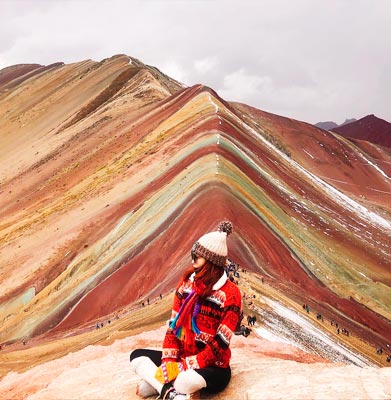
Day 14: Rainbow Mountain (Vinicunca) Full-Day Excursion
Your day will begin with an early pickup from your accommodation in Cusco, between 4:30 and 5:00 am. Our private transportation will take you from the south of Cusco to the town of Cusipata. The transfer lasts approximately 1 hour and 30 minutes. Upon arrival in Cusipata, we will have breakfast. After breakfast, we will continue our trip to the Rainbow Mountain for about 1 hour and 15 minutes. On the way to the mountain, you will have the chance to enjoy beautiful landscapes and to see the wildlife.
We will start our adventure with a walk uphill for about 1 hour and a half, appreciating in the background snowy mountains and wonderful landscapes. Then, we will finally reach the point to which we will be able to appreciate the colors of the Rainbow Mountain and the stunning view it offers.
After visiting and taking pictures, we will return the same way we came with a 1.5-hours hike, have lunch, and start the drive back to Cusco, arriving between 5:00 and 5:30 pm.
Day 15: Return to Lima
After breakfast, you will check out of your hotel and be transferred to Cusco Airport for your onward journey. If your flight is later in the day, you may have some free time for last-minute shopping or exploring nearby attractions. Upon your arrival in Lima, you will connect with your international flight back to your country.
Price
Tours Only
USD$1,480 .00Per Person
Accommodation not included.
This option is perfect for travelers who prefer full flexibility during their trip. You may choose and book your own hotels, hostels, or accommodations in each destination according to your travel style and budget.
Suggested stay plan:
2 nights in Lima
1 night in Nazca
2 nights in Arequipa
1 night in Chivay
2 nights in Puno
1 night in Aguas Calientes
5 nights in Cusco
Package Details
✓ 15 Days / 14 Nights
✓ Scheduled Group Tours
✓ Professional Local Guides
✓ Tourist Transportation
✓ Entrance Tickets Included
✓ You Choose Your Hotels
Best for: Independent travelers who prefer to book their own accommodation.
Tour + Standard Hotels
USD$1,980.00Per Person
14 nights of accommodation in carefully selected standard hotels.
2 nights in Lima
1 night in Nazca
2 nights in Arequipa
1 night in Chivay
2 nights in Puno
1 night in Aguas Calientes
5 nights in Cusco
Package Details
✓ 15 Days / 14 Nights
✓ 14 Hotel Nights
✓ Scheduled Group Tours
✓ Professional Local Guides
✓ Tourist Transportation
✓ Entrance Tickets Included
Accommodation: Carefully selected standard hotels.
Best for: Travelers looking for comfort and good value.
Tour + 3–4 Star Hotels
USD$ 2,380.00Per Person
14 nights of accommodation in carefully selected 3 to 4-star hotels.
2 nights in Lima
1 night in Nazca
2 nights in Arequipa
1 night in Chivay
2 nights in Puno
1 night in Aguas Calientes
5 nights in Cusco
Package Details
✓ 15 Days / 14 Nights
✓ 14 Hotel Nights
✓ 3–4 Star Accommodation
✓ Scheduled Group Tours
✓ Professional Local Guides
✓ Tourist Transportation
✓ Entrance Tickets Included
Accommodation: Carefully selected 3–4 star hotels.
Best for: Travelers who prefer a higher level of comfort.
Additional Upgrades for
- Huayna Picchu Mountain: $70 USD (subject to availability)
- Machu Picchu Mountain: $70 USD (subject to availability)
- Upgrade to Vistadome Train – Panoramic Train (if you choose the train return option)
Train schedule
How long does the return trip to Cusco take?
The return journey to Cusco takes approximately 3 hours. First, you will board a train in Aguas Calientes, which will take you to the Ollantaytambo train station for 1 hour and 30 minutes. Then, a transfer from our office will be waiting for you at the train station exit with a sign bearing your name to drive you back to Cusco in a car or van for approximately 1 hour and 30 minutes. Finally, they will drop you off at your hotel or hostel. You will receive your train tickets once your Machu Picchu tour has concluded.
What to bring
What you need to bring:
Travel Essentials
- Original Passport and copies
- Flight tickets and travel documents
- Travel insurance information
- Credit/debit cards and some cash (Peruvian soles and USD)
Clothing
- Lightweight, breathable clothes for daytime (t-shirts, long-sleeve shirts)
- Warm layers for high-altitude destinations (fleece or sweater, thermal underwear)
- Waterproof/windproof jacket or poncho
- Comfortable pants for trekking/hiking
- Shorts or light pants for lower-altitude areas like Lima or Ica
- Hat or cap for sun protection
- Sunglasses with UV protection
- Swimwear (for hot springs in Chivay or hotel pools)
- Sleepwear
- Footwear
- Comfortable walking shoes for city tours and museums
- Sturdy shoes for Rainbow Mountain, Colca Canyon, and Machu Picchu
- Sandals or flip-flops for hotel or relaxing
Accessories
- Small daypack/backpack for daily excursions
- Reusable water bottle
- Travel towel (optional, some hotels provide them)
- Camera, smartphone, and chargers
Health & Hygiene
- Sunscreen (high SPF) and lip balm
- Mosquito repellent (especially for Machupicchu)
- Personal medications and first-aid kit (band-aids, pain relievers, altitude sickness medication)
- Hand sanitizer and wet wipes
- Toiletries (toothbrush, toothpaste, shampoo, soap, deodorant)
Altitude Preparation
- Diamox (consult your doctor) or other remedies for altitude sickness
- Energy snacks (nuts, chocolate, granola bars)
- Hydration tablets or electrolyte powder
Optional Items
- Travel pillow for overnight bus rides
- Waterproof phone case or dry bag for Lake Titicaca and desert activities
- Lightweight scarf or buff for dust protection in desert areas
Tips:
- Pack light but in layers; temperatures can vary from warm coastal areas to freezing highlands.
- Avoid cotton for high-altitude trekking—it doesn’t keep you warm when wet.
- Always have a small daypack with essentials during excursions.
Why Us
Why does Inka Trail Backpacker charge less than other Inca Trail operators?
At Inka Trail Backpacker, we offer you the basic and essential version of the popular treks in the region and because we are a 100% local company we know the real cost of operations and everything you will need. That is why our slogan is “Fun. Not Fancy Trip.”
Are you a certified company?
In Peru, all tour companies and travel agencies must be officially certified by the government to operate legally and safely. This ensures that the company is trustworthy, follows safety rules, and provides a high-quality experience.
Inka Trail Backpacker has been a Licensed Inca Trail Tour Operator since 2014. All companies managing the Inca Trail must be certified and have an Inca Trail operators license. This license is issued annually each December; Inka Trail Backpacker is licensed through the year of 2030.
Our license as an Official Travel Agency is under the name Inka Trail Backpacker E.I.R.L. Our License as an Inca Trail Operator is under the name of INKA TRAIL BACKPACKER E.I.R.L
We also have a registered travel agency in Peru (official RUC and local licensing), so all our services are fully legal and authorized.
Our Certifications
Registered Tour Operator
We are officially listed in the National Tourism Registry (RNT) by the Ministry of Foreign Trade and Tourism (MINCETUR). This guarantees that we are legally allowed to provide tourism services anywhere in Peru.
Certified Guides
All our tour guides are officially certified by MINCETUR, trained in safety, local culture, and languages, to give you the best experience.
Protected Areas & Special Activities
For tours in national parks, Machu Picchu, or adventure activities, we hold the necessary special permits to operate safely and legally.
Why it matters for you:
Booking with Inka Trail Backpacker ensures a safe, reliable, and high-quality experience. You can trust that all our tours are fully authorized and professionally managed.
Trek with like-minded travellers
As a traveller, you know that one of the most rewarding and memorable experiences of going to new places is meeting people along the way. When you book a tour with us, you can be confident that your group will be filled with similar travellers looking for adventure in the Peruvian Andes. Our groups provide a great opportunity to meet new people and bond with them in an exciting environment. You never know who you will meet!
Community
We are really proud of the work we do for our community. This is a main focus for our company. We have worked with villages directly to help supply them with needs, buy all our food from local farmers and markets, and serve the freshest ingredients.
Office Location
Our office is located close to Main Square at 392 Calle Triunfo (the street is also called Sunturwasi), inside the Centro Artesenal Arte Inka Building, which is on the corner across the street from the Museo Arzobispal and the Twelve-Angled Stone, by a small fountain. We are on the second floor, in Suite 209.
Travel Info
When is the best time to visit Peru?
The best time to visit Peru depends on which regions you plan to explore, because Peru has very different climates in the coast, mountains, and jungle. Here’s a clear breakdown:
1. Andes / Cusco, Machu Picchu, Sacred Valley
Best time: May to September (dry season)
Skies are mostly clear, ideal for trekking and sightseeing.
Cooler temperatures, especially at night.
November to March (rainy season)
2. Lima & Peruvian Coast
Best time: December to April
Warm and sunny; perfect for beaches and coastal activities.
Avoid: June to September
Coastal fog and drizzle (locally called garúa).
3. Amazon / Jungle Regions
Best time: May to September (dry season)
Easier trekking, fewer mosquitoes, rivers lower but navigable.
Wet season: November to March
Rain can flood some areas and make jungle trails harder.
Special Notes
High season: June to August → most tourists, especially in Cusco and Machu Picchu. Book flights and tickets early.
Shoulder season: April, May, September → good weather and fewer crowds.
Pro tip: If your goal is trekking the Inca Trail, the dry season (May–September) is essential, because the trail closes in February for maintenance.
Do I need a visa to travel to Peru?
Most tourists from North America, Europe, Australia, and many countries in Latin America do not need a visa for stays up to 90 days. Check your country’s requirements before traveling.
What currency is used in Peru?
The official currency is the Peruvian Sol (PEN). US dollars are widely accepted in tourist areas, but it’s recommended to have local currency for small purchases, markets, and transport.
Do I need vaccinations before traveling to Peru?
Routine vaccines (tetanus, hepatitis A/B, typhoid) are recommended. Yellow fever vaccination is required only if visiting the Amazon. Always check with your doctor before traveling.
Will I experience altitude sickness?
Yes, some destinations like Cusco (3,400 m), Puno (3,800 m), and Rainbow Mountain (5,200 m) are high-altitude areas. Drink plenty of water, avoid alcohol on arrival, eat light meals, and walk slowly. Medication like Diamox can help if recommended by a doctor.
What should I do if I feel sick at high altitudes?
Rest, stay hydrated, avoid strenuous activity, and descend if symptoms worsen. Always carry altitude sickness medicine if recommended.
What kind of clothing should I pack?
Pack in layers: light clothing for coastal areas (Lima, Ica), warm layers for highlands (Cusco, Puno, Colca Canyon), waterproof jackets for rainy areas, and sun protection (hat, sunglasses, sunscreen).
How do we travel between cities?
Transfers are usually by:
-
Tourist Van or buses: comfortable for Ica, Nazca, Arequipa, Puno, Cusco.
-
Domestic flights: convenient for longer distances (Lima ↔ Cusco).
-
Trains: used for Aguas Calientes (base town for Machu Picchu).
Are buses safe and comfortable for overnight trips?
Yes. Peru has modern tourist buses with reclining seats, blankets, and snacks. Recommended for Nazca → Arequipa or Puno → Cusco.
Faqs
What types of hotels are included in the tour?
Hotels are usually 3-4 star, centrally located, with private bathrooms and basic amenities. Some smaller towns may have cozy boutique hotels.
Are meals included?
Typically, breakfast is included at hotels. Some tours include lunch, especially on day trips. Dinner is usually on your own.
Can I try local food safely?
Yes, popular dishes include ceviche, lomo saltado, alpaca steak, cuy (guinea pig), and Peruvian desserts. Drink bottled water and avoid street food if unsure.
Are all activities on the tour mandatory? How flexible are itineraries?
At Inka Trail Backpacker, we are committed to providing your ideal experience in Peru. Therefore, if there are any adjustments you would like to make to reflect your fitness level, lifestyle, or personal interests, we are happy to help! Our itineraries are reasonably flexible and activities can be removed or substituted as necessary.
Should I tip the guides? How much is appropriate?
A tip is customary, but the amount is at your discretion and whatever you feel is appropriate based on the service you have received; please remember to always be courteous and respectful with our guides.
Are all excursions suitable for children or elderly travelers?
Most city tours, cultural sites, and boat trips are suitable. High-altitude hikes like Rainbow Mountain may not be recommended for very young children, elderly travelers, or those with health issues.
Do I need to speak Spanish?
All of our guides are bilingual and speak both Spanish and English.